Why Sellmitra is the Best Shopify Alternative in India
Compare Sellmitra and Shopify to find the right ecommerce platform for your business. Learn about pricing, mobile-first features, zero commission, and Indian-focused tools.

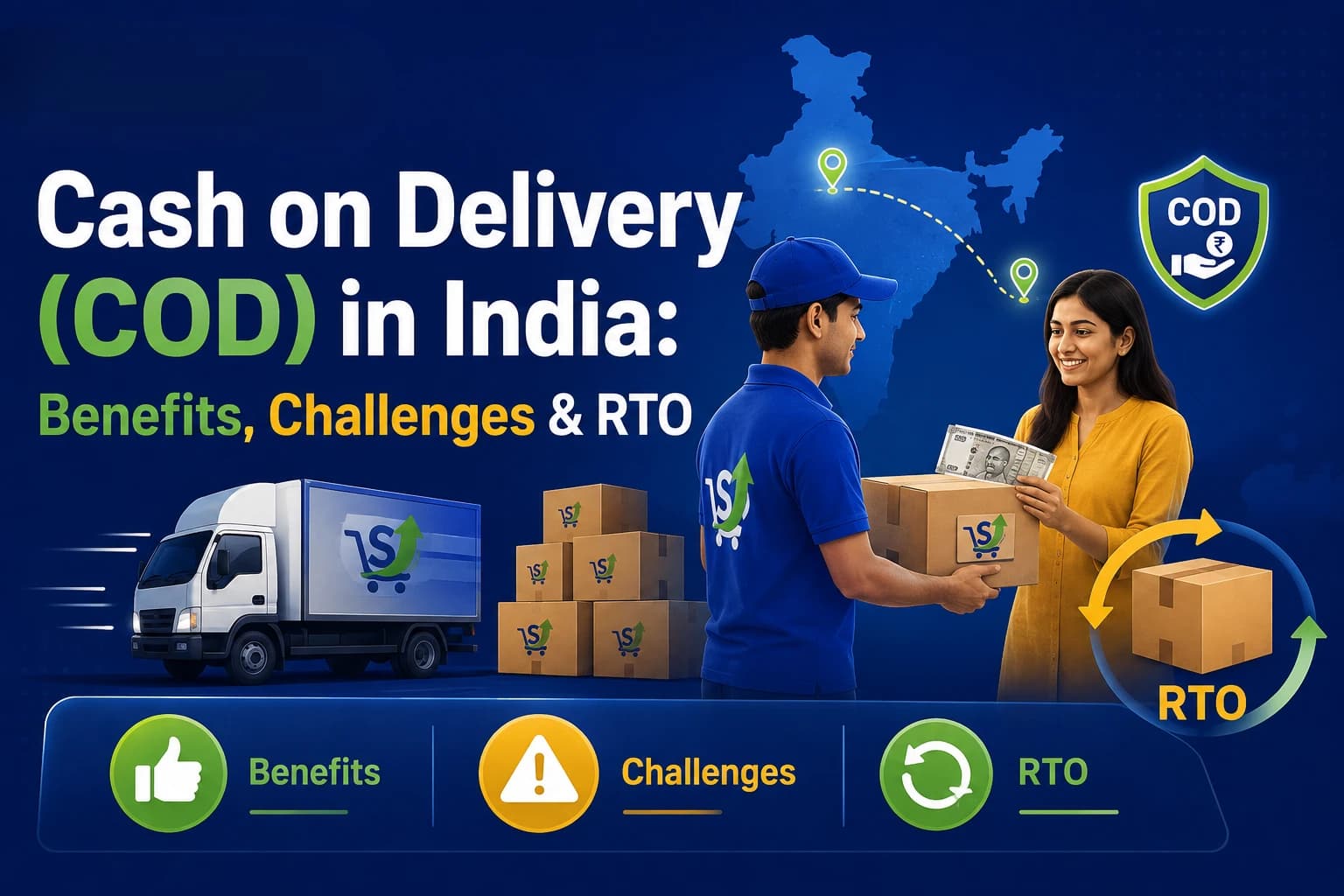
Imagine you're planning to buy a pair of shoes from a website you've never heard of before.
The price is attractive, the pictures look good, and the reviews seem genuine. You reach the checkout page and see two payment options:
Which one would you choose?
For many Indian shoppers, the answer is obvious: Cash on Delivery.
It's not because they don't know how to use UPI or online banking. In fact, India is one of the world's leaders in digital payments. The real reason is something much simpler: Trust.
Many customers think:
"I'll pay only after I receive the product."
That single thought has made Cash on Delivery one of the most important payment methods in Indian ecommerce.
But while customers love COD, sellers often have a very different experience.
A customer places an order on Monday.
The seller packs the product on Tuesday.
The courier picks it up the same day.
The parcel travels hundreds of kilometres.
It reaches the customer's doorstep.
The delivery executive calls...
"Sir, your parcel has arrived."
And suddenly the customer says,
"I don't need it anymore."
Or worse,
"I never ordered this."
The package begins its journey back to the seller.
The seller has now paid for shipping twice, lost valuable time, tied up inventory, and may even end up with a damaged product. This is called Return to Origin (RTO), and it's one of the biggest operational challenges in Indian ecommerce.
So, while COD helps businesses attract more customers, it also brings higher costs and greater risks.
This article explores why Cash on Delivery remains so popular in India, why customers continue to choose it even in the age of UPI, and how it contributes to increasing RTO rates. Understanding these challenges is the first step toward building a healthier and more profitable ecommerce business.
Cash on Delivery, commonly known as COD, is a payment method where customers pay only after the product reaches their doorstep.
Unlike prepaid orders, customers don't have to make any payment while placing the order. They pay the delivery executive when the package is delivered, using cash or, in many cases today, digital payment methods like UPI.
Let's look at a simple example.
ExampleRahul wants to buy a smartwatch worth ₹2,999 from an online store.
Instead of paying online, he selects Cash on Delivery.
The seller ships the order.
Three days later, the courier arrives at Rahul's home.
Rahul checks the package and then pays ₹2,999 before accepting the delivery.
Only after receiving the payment does the courier mark the order as successfully delivered.
For the customer, this feels safer because they don't have to trust the website with their money before the product is dispatched.
Many first-time online shoppers confuse these two payment methods. Here's a simple comparison.
| Feature | Cash on Delivery | Prepaid Order |
|---|---|---|
| Payment timing | After delivery | Before shipment |
| Upfront payment | No | Yes |
| Customer confidence | Higher for new buyers | Depends on trust in the seller |
| Seller receives payment | After delivery | Before shipping |
| Risk of delivery refusal | Higher | Lower |
Neither option is universally better. They simply serve different customer needs.
For established brands like Amazon or Flipkart, many customers are comfortable paying in advance because they already trust the platform.
For a newly launched D2C brand or an independent online store, many shoppers prefer COD until they've had a positive experience with the business.
To understand why COD is still thriving, we need to go back to the early days of Indian ecommerce.
When online shopping started becoming popular, digital payments weren't as convenient as they are today.
Many people didn't own credit cards.
Internet banking was complicated.
Mobile wallets were still emerging.
UPI didn't even exist.
At that time, Cash on Delivery solved a major problem.
Customers could order products online without worrying about online payments.
This simple option helped millions of Indians try ecommerce for the first time.
Even though India's payment ecosystem has changed dramatically since then, customer behaviour doesn't change overnight.
Habits built over many years often continue long after technology improves.
This is one of the most interesting questions in Indian ecommerce.
Today, paying online is incredibly easy.
A customer can complete a UPI payment in just a few seconds.
According to PCMI (Payments and Commerce Market Intelligence), UPI now accounts for more than 75% of India's digital payment transaction volume, making it the country's dominant digital payment method.
Yet ecommerce tells a different story.
According to a 2026 report by The Economic Times, citing industry executives, nearly half of all online orders in India are still placed using Cash on Delivery.
At first glance, this seems surprising.
If online payments are so easy, why aren't all ecommerce orders prepaid?
The answer is simple.
People trust UPI. They don't always trust every online store.
That's an important difference.
Customers aren't avoiding digital payments.
They're avoiding the risk of paying an unfamiliar seller before receiving the product.
Let's imagine two situations.
You are ordering a mobile phone from Amazon.
You've purchased from Amazon before.
Your previous orders arrived on time.
Returns were easy.
Refunds were processed quickly.
Would you feel comfortable paying online?
Probably yes.
Now imagine you discover a new website through an Instagram advertisement.
The products look attractive.
The prices are lower than other stores.
But you've never heard of the company before.
Would you pay ₹5,000 in advance?
Many people wouldn't.
Instead, they'd choose COD.
Not because they dislike online payments.
Because they haven't yet built trust in the seller.
This is why Cash on Delivery continues to play such an important role, especially for new ecommerce businesses trying to acquire first-time customers.
Every customer has their own reasons, but most of them fall into a few common patterns.
This is perhaps the biggest reason.
Customers feel safer knowing they don't have to part with their money until the product actually reaches them.
It's similar to buying something from a local shop.
You see the product.
You pay.
You take it home.
COD gives customers a similar feeling of control.
Although online shopping has become much safer, scams still make headlines.
Customers occasionally hear stories about:
These incidents make people cautious, especially when shopping from a brand they've never used before.
For many buyers, COD acts as a safety net.
Imagine ordering a wooden dining table from a website you've never used before.
The photographs look beautiful.
But questions remain.
When customers choose COD, they feel they still have some control over the purchase journey.
Even though they must pay before accepting the parcel, psychologically they feel less exposed because they haven't paid days in advance.
A customer may happily prepay on the second or third purchase after having a good experience.
But during the first purchase, they often prefer COD because they haven't yet developed confidence in the seller.
Think of it like meeting someone new.
Trust isn't built instantly.
It's earned through positive experiences.
Online shopping works in much the same way.
Millions of Indians have been using Cash on Delivery for more than a decade.
Once a habit becomes comfortable, people rarely change it unless there's a strong reason.
Even customers who regularly pay electricity bills, recharge their phones, and transfer money through UPI may still choose COD while buying products online.
The issue isn't technology.
It's familiarity.
After reading about why customers love COD, you might wonder:
"If COD creates so many problems for sellers, why do almost every ecommerce store still offer it?"
The answer is simple.
Because COD increases sales.
If many Indian online stores removed the Cash on Delivery option overnight, they would likely see a noticeable drop in orders, especially from first-time customers.
Think about a new clothing brand you've just discovered on Instagram.
You like one of their shirts, but you've never purchased from them before.
If the website only allows prepaid orders, you might think:
"I'll buy it later."
Most of the time,"later" never comes.
But if the same store offers COD, you're much more likely to place the order immediately because there's very little perceived risk.
That's why COD continues to be an important conversion tool for ecommerce businesses.
The biggest benefit of COD is peace of mind.
Customers know they don't have to pay before the seller ships the product.
This is especially important when buying from:
For these businesses, COD helps overcome the initial trust barrier.
Imagine opening a new bakery in your city.
People may hesitate to order from you the first time.
But after tasting your products once, they'll happily return.
Online shopping works the same way.
COD often helps businesses get that crucial first order.
Once customers have a positive experience, many are willing to prepay for future purchases.
Customers feel more comfortable because they believe they have greater control over the purchase.
Even though the payment must still be made before accepting the parcel, psychologically they don't feel like they're risking their money several days in advance.
That feeling alone increases purchase confidence.
Not every customer shops the same way.
Some people always pay online.
Others always choose COD.
Offering both options allows customers to pay in the way they're most comfortable with.
More payment choices generally lead to fewer abandoned carts.
At first, this might sound surprising.
After all, this article is about the problems caused by COD.
But before understanding those problems, it's important to understand why businesses continue offering it.
One of the biggest reasons merchants offer COD is because it helps convert hesitant visitors into paying customers.
Imagine two online stores selling the same product.
Store AWhich store is more likely to receive orders from first-time buyers?
Most people would choose Store B.
That's why COD often improves conversion rates, especially for newer brands.
India is incredibly diverse.
Customers in metropolitan cities often feel comfortable paying online.
However, many shoppers in Tier 2, Tier 3, and smaller towns still prefer COD because they feel it's safer.
By offering COD, businesses can reach customers who might otherwise avoid purchasing altogether.
Imagine searching for the same mixer grinder on two different websites.
Everything is almost identical.
The price is similar.
Delivery time is similar.
But one website offers COD while the other doesn't.
Many shoppers will naturally choose the store that offers greater payment flexibility.
Sometimes, simply offering COD can influence the buying decision.
Now let's look at what happens after a customer places a COD order.
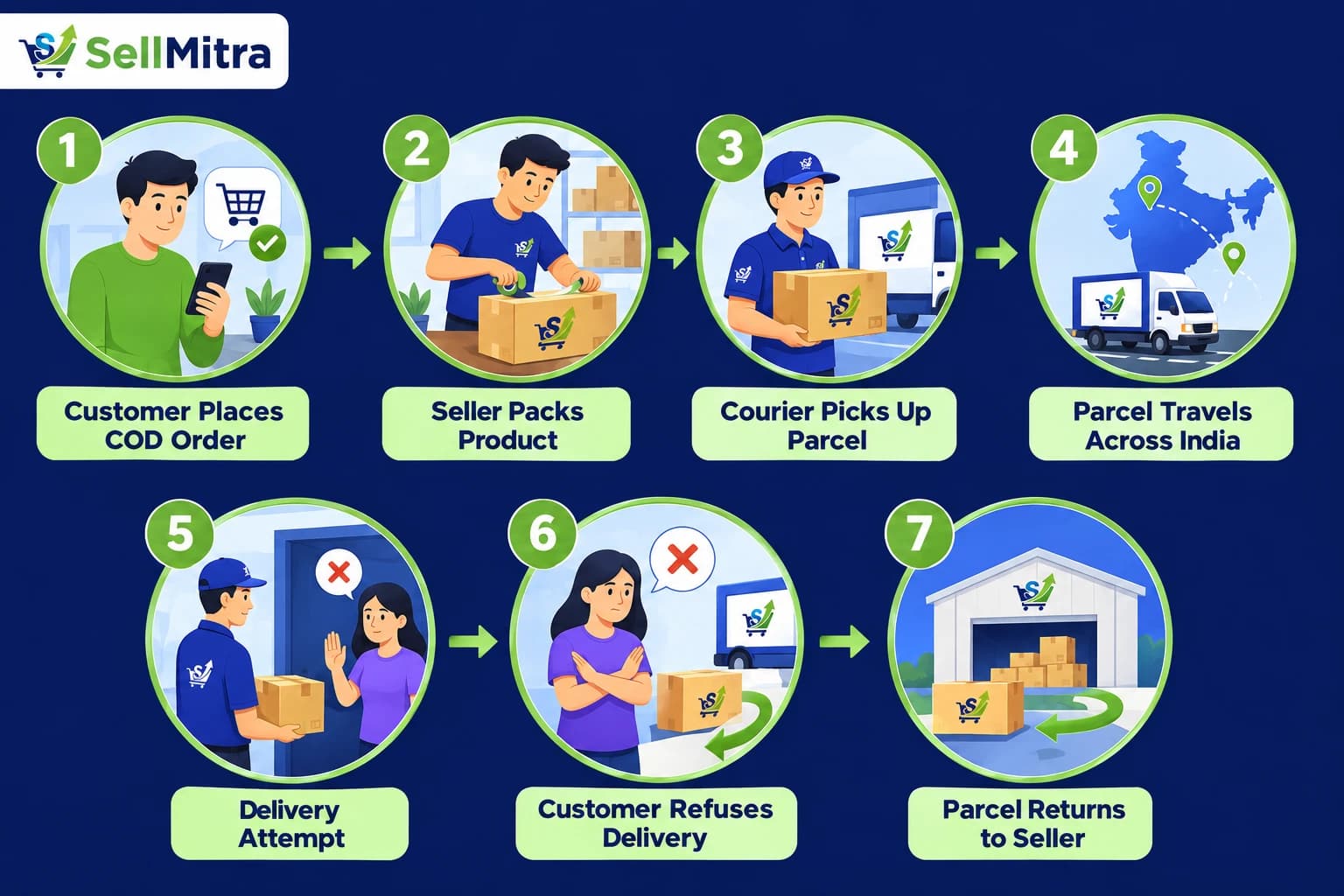
At first glance, it may seem like nothing major has happened.
The customer simply didn't buy the product.
But from the seller's perspective, the damage has already been done.
The product has travelled hundreds or even thousands of kilometres.
Packaging materials have been used.
Warehouse staff spent time processing the order.
Shipping charges have already been paid.
Now the seller must also pay to bring the product back.
This entire process is called Return to Origin, or RTO.
Return to Origin (RTO) is the process in which a shipped parcel is returned to the seller because the customer did not accept delivery.
Unlike a normal return, an RTO usually happens before the order is successfully delivered.
The product starts at the seller's warehouse.
It reaches the customer's city.
Sometimes it even reaches the customer's doorstep.
But because delivery couldn't be completed, the parcel travels all the way back.
In simple terms,
RTO means the seller pays to ship the product twice but earns nothing from the order.
That's why ecommerce businesses pay close attention to their RTO rate.
Let's imagine an online fashion store.
A customer orders a jacket worth ₹2,500 using COD.
The seller immediately begins processing the order.
Three days later, the delivery executive reaches the customer's address.
The customer says,
"Sorry, I changed my mind."
The courier returns the parcel.
The seller receives the jacket after another few days.
What happened?
The sale never happened.
But the seller still spent money on:
The customer lost nothing.
The seller absorbed almost every cost.
Multiply this by hundreds or even thousands of orders every month, and you can understand why RTO becomes a serious business problem.
One of the biggest misconceptions is that customers refuse delivery because they are unhappy with the product.
In reality, many RTO orders happen before customers even see what's inside the package.
Let's look at some of the most common reasons.
This is probably the most common reason.
The customer placed the order impulsively.
A few days later, they no longer wanted it.
Because no money had been paid upfront, cancelling felt easy.
Imagine bookmarking a product versus actually paying for it.
People naturally feel less committed when they haven't invested any money.
Suppose someone orders wireless earbuds for ₹1,999.
The next day they see another website selling the same product for ₹1,699.
By the time the first parcel arrives, they simply refuse delivery.
This happens more often than many people realize.
A teenager orders a gaming keyboard.
Parents refuse permission.
Or a customer orders a decorative item.
Later their spouse says,
"We don't really need this."
The easiest solution becomes refusing the delivery.
Sometimes nobody is at home.
Sometimes people travel unexpectedly.
Sometimes delivery attempts fail repeatedly.
Eventually the courier marks the shipment as undeliverable and returns it to the seller.
Unfortunately, fake orders remain a challenge for many online businesses.
Someone enters an incorrect address.
Or provides someone else's phone number.
Or simply places an order without any intention of accepting it.
Since no advance payment is required under traditional COD, fake orders can be relatively easy to place.
Imagine ordering a birthday gift.
Expected delivery:
Friday.
Actual delivery:
Tuesday next week.
The birthday has already passed.
The customer no longer needs the product.
Another RTO is created.
Many people think an RTO only means losing one sale.
In reality, one returned parcel creates multiple operational problems.
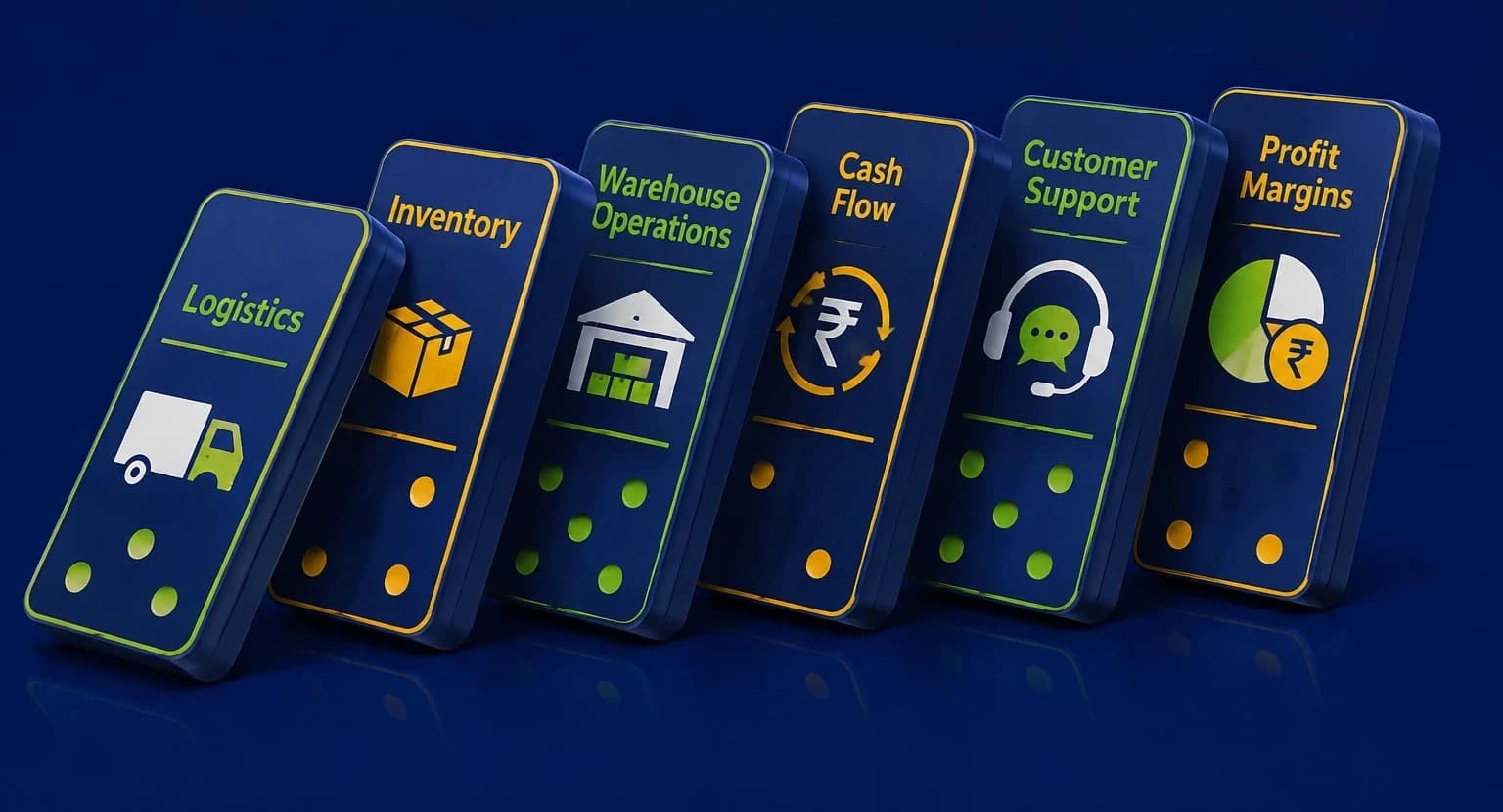
It affects:
Think of it like throwing a stone into a pond.
The splash is small.
But the ripples spread much further.
RTO works the same way.
One refused order creates costs across multiple departments, even though no revenue is generated.
Many new ecommerce sellers make one common mistake.
They look at an RTO order and think,
"The customer didn't buy the product, so I simply lost one sale."
Unfortunately, the loss is much bigger than that.
An RTO doesn't just reduce revenue. It increases expenses across almost every stage of your business.
Let's understand this with a simple example.
A Real-World ExampleSuppose you sell premium backpacks online.
A customer places a COD order worth ₹2,000.
You happily receive the order and begin processing it.
Here's what happens behind the scenes.
Your warehouse staff:
Even before the parcel leaves your warehouse, you've already spent money on manpower, packaging materials, and order processing.
The courier now transports the parcel.
Whether the customer accepts it or not, the courier still charges you for shipping.
Three days later, the delivery executive reaches the customer's doorstep.
The customer says,
"Sorry, I don't want it anymore."
At this point, the courier doesn't simply throw the parcel away.
It starts travelling back to your warehouse.
Now you pay shipping again.
This is called reverse logistics.
The same parcel has now travelled twice.
Once the parcel comes back, your team still has work to do.
They must:
Sometimes the product can't even be sold as new anymore.
Here's a simplified view.
| Expense | Happens Even If Customer Refuses? |
|---|---|
| Product Picking | ✅ Yes |
| Packaging Material | ✅ Yes |
| Warehouse Labour | ✅ Yes |
| Forward Shipping | ✅ Yes |
| Reverse Shipping | ✅ Yes |
| Inventory Handling | ✅ Yes |
| Customer Support | ✅ Yes |
| Sale Revenue | ❌ No |
That's why experienced ecommerce sellers don't look at RTO as"just a cancelled order."
They see it as a business expense that directly affects profitability.
Let's imagine you receive 100 COD orders this week.
Each order is worth ₹1,500.
At first glance, it looks like you've sold products worth ₹1,50,000.
Naturally, you're excited.
But suppose 30 customers refuse delivery.
Now things look very different.
Instead of receiving payment from all 100 customers:
Your money is stuck.
This is called working capital blockage.
Instead of using that money to buy new inventory or grow your business, you're waiting for returned parcels to come back.
For small businesses, this can become a serious challenge.
Imagine owning a clothing store.
You have only 20 pieces of a popular jacket.
Ten customers place COD orders.
You ship all ten.
Three customers refuse delivery.
Those three jackets spend nearly two weeks travelling across the country before returning to your warehouse.
During those two weeks:
Inventory earns money only when it's available for sale.
When it's travelling unnecessarily because of RTO, it becomes locked inventory.
Every RTO order usually creates additional conversations.
Customers may call asking:
"Where is my order?"
Delivery executives may call several times.
Support teams follow up.
Warehouse staff coordinate with courier partners.
Operations teams update order statuses.
Each interaction consumes time.
Even though the order never generated revenue.
One or two returned orders may not seem significant.
But imagine handling hundreds of them every month.
The operational workload increases dramatically.
At this point, you might wonder:
"If COD causes so many problems, why not disable it completely?"
It's a reasonable question.
Unfortunately, the answer isn't that simple.
Imagine you're running a new online store.
You remove the COD option.
A customer discovers your website through Instagram.
They like your products.
They reach the checkout page.
The only available option is prepaid payment.
Now the customer starts asking questions.
Within seconds, doubt replaces excitement.
Many customers simply close the website without completing the purchase.
This is known as cart abandonment, and it represents lost sales before an order is even placed.
For many Indian ecommerce businesses, especially newer brands, completely removing COD can significantly reduce conversion rates because it removes the payment option many first-time buyers trust most.
Cash on Delivery isn't the enemy.
In fact, it's one of the reasons ecommerce became so successful in India.
The real challenge is finding ways to keep the benefits of COD while reducing its risks.
Over the years, ecommerce businesses have adopted several strategies to achieve this.
Some verify customer phone numbers using OTP.
Some restrict COD for high-risk PIN codes.
Some charge a small COD handling fee.
Some analyze past purchase behaviour before offering COD.
And increasingly, many businesses are exploring Partial Advance Payment, where customers pay a small amount upfront and the remaining balance upon delivery.
This approach helps create a stronger purchase commitment while preserving the convenience that customers value.
We'll explore this solution in detail in the next article.
Cash on Delivery has played a crucial role in shaping India's ecommerce industry. It gave millions of customers the confidence to shop online for the first time and continues to help businesses reach buyers who prefer paying after delivery.
But every convenience comes with a cost.
For sellers, COD introduces challenges such as higher Return to Origin (RTO) rates, increased logistics expenses, delayed cash flow, and operational inefficiencies. As an ecommerce business grows, these costs can quietly reduce profitability if they aren't managed carefully.
The good news is that businesses don't have to choose between full COD and no COD.
Modern ecommerce is moving toward smarter payment models that preserve customer trust while encouraging genuine purchase intent.
One of the most effective approaches is Partial Advance Payment, where customers pay only a small amount upfront and the remaining balance on delivery.
In our next article, we'll explore how Partial Advance Payment works, why it reduces RTO, and how it creates a win-win situation for both customers and ecommerce businesses.

Join our WhatsApp channel for quick tips, product updates, and ideas to help you grow your online store efficiently.
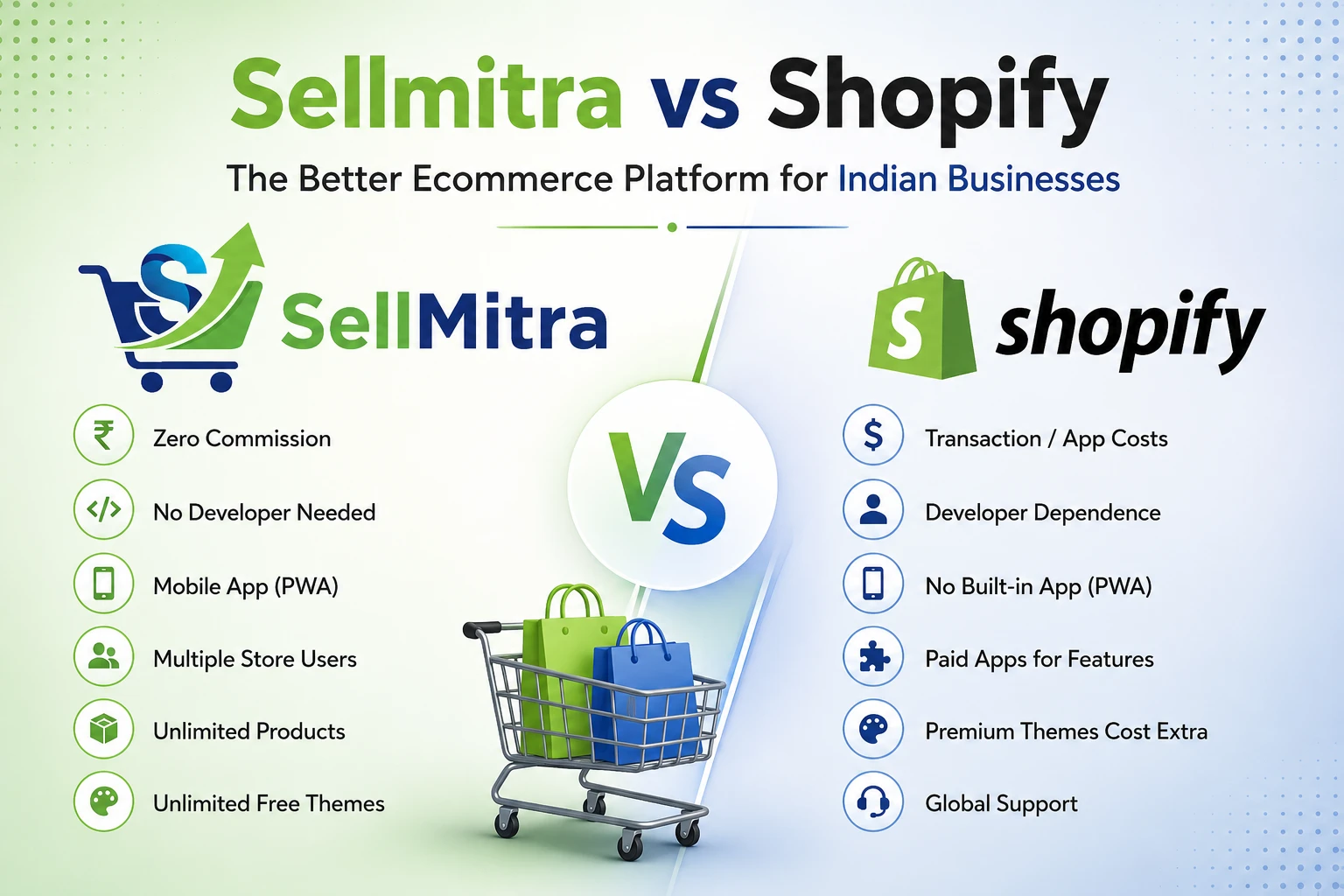
Compare Sellmitra and Shopify to find the right ecommerce platform for your business. Learn about pricing, mobile-first features, zero commission, and Indian-focused tools.
Discover why mobile apps are transforming ecommerce in India. Learn the benefits of PWAs, mobile commerce trends, and how they help grow sales.

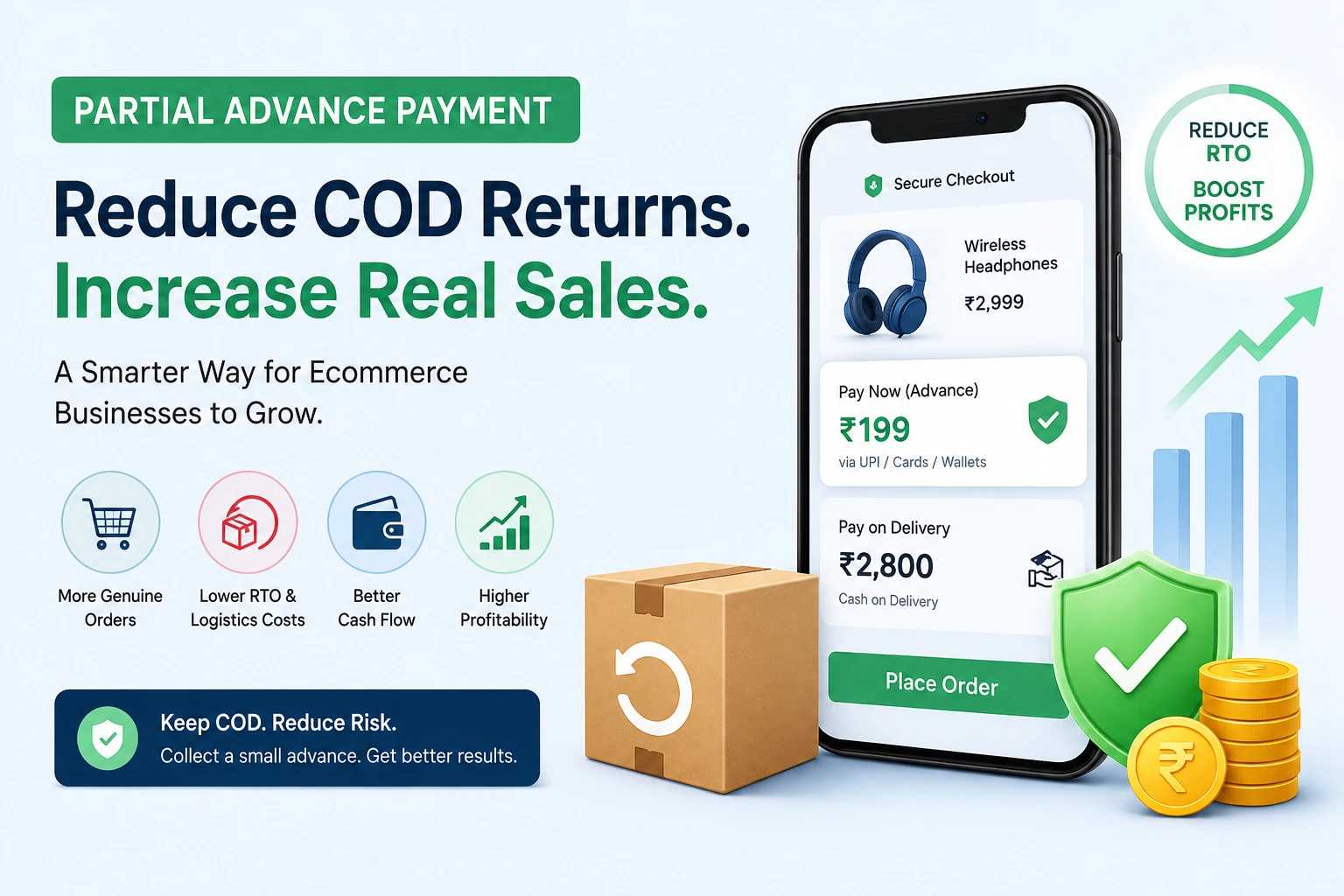
Learn how Partial Advance Payment helps ecommerce businesses reduce RTO, improve cash flow, increase genuine orders, and build customer trust without removing Cash on Delivery.
We can help you to create your dream website for better business revenue.