Why Sellmitra is the Best Shopify Alternative in India
Compare Sellmitra and Shopify to find the right ecommerce platform for your business. Learn about pricing, mobile-first features, zero commission, and Indian-focused tools.

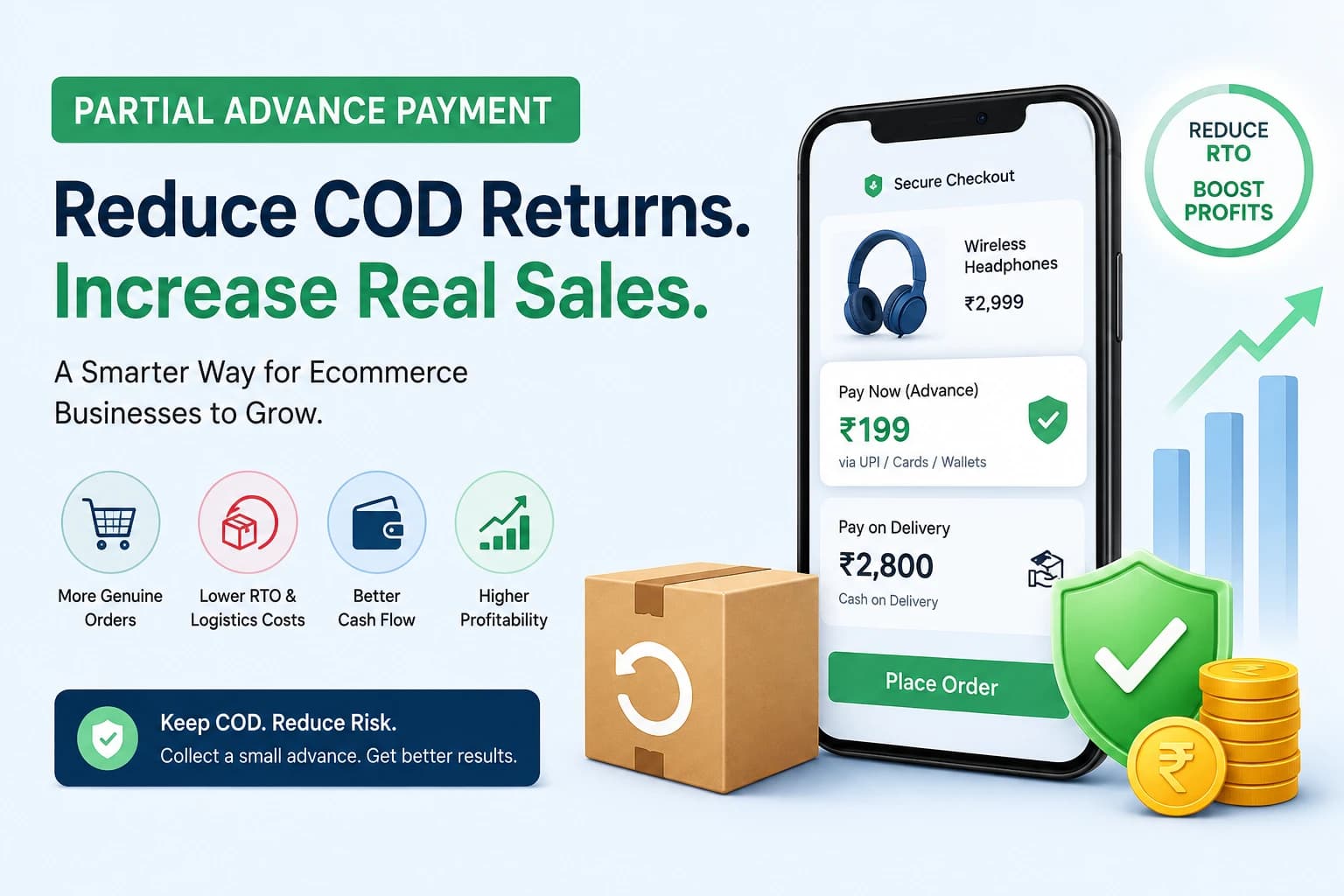
In our previous article, we explored why Cash on Delivery (COD) continues to be one of the most preferred payment methods in India. We also looked at how it helps businesses attract customers but can lead to higher Return to Origin (RTO) rates, increased logistics costs, and delayed cash flow.
If removing COD isn't the answer, what is?
Many successful ecommerce businesses aren't eliminating COD. Instead, they're making it smarter.
One of the most practical approaches is Partial Advance Payment.
Instead of asking customers to pay the full order amount upfront or nothing at all, businesses collect a small advance payment when the order is placed. The remaining amount is paid when the order is delivered.
At first, it sounds like a small change.
But in practice, this simple payment model can make a significant difference. It helps businesses receive more genuine orders, reduces impulsive purchases, improves cash flow, and lowers the chances of orders being returned.
More importantly, customers still enjoy the convenience of Cash on Delivery.
It isn't about replacing COD.
It's about making COD work better for everyone.
Partial Advance Payment is a checkout option where customers pay only a portion of the order value while placing the order, and the remaining balance is collected when the product is delivered.
Think of it like booking a holiday package.
Many travel companies ask for a booking amount to confirm the reservation, while the remaining payment is made closer to the travel date.
The booking amount doesn't mean you're paying for the entire trip immediately. It simply confirms that you're serious about your reservation.
Partial Advance Payment follows the same idea.
Customers pay a small amount to confirm their order, while enjoying the flexibility of paying the balance after delivery.
Let's look at a simple example.
Product Price: ₹1,200
Payment at Checkout:₹100
Payment on Delivery:₹1,100
Product Price: ₹4,500
Advance Payment:10% (₹450)
Balance on Delivery:₹4,050
Product Price: ₹18,000
Advance Payment:₹1,000
Balance on Delivery:₹17,000
In every example, customers don't have to pay the entire amount before shipping.
At the same time, sellers receive confirmation that the customer has made a financial commitment toward the purchase.
There isn't a single payment method that's perfect for every business.
Each has its own advantages.
| Feature | Full COD | Partial Advance Payment | Full Prepaid |
|---|---|---|---|
| Payment at checkout | None | Small amount | Full amount |
| Payment on delivery | Full amount | Remaining balance | No |
| Customer confidence | High | High | Depends on brand trust |
| Seller risk | High | Moderate | Low |
| Fake order risk | Higher | Lower | Very Low |
| RTO risk | Higher | Lower | Lowest |
Partial Advance Payment sits comfortably between the two traditional payment methods.
It gives customers confidence while giving sellers additional protection.
Running an ecommerce business isn't just about getting more orders.
It's about getting better orders.
Imagine two stores.
Receives 150 COD orders.
Thirty customers refuse delivery.
Only 120 orders generate revenue.
Receives 135 Partial Advance Payment orders.
Only five customers refuse delivery.
A much larger percentage of orders are successfully completed.
Although Store B received fewer orders, it generated more successful deliveries.
For most businesses, that's a better outcome.
Because at the end of the day, successful deliveries matter more than order count.
Let's look at an everyday example.
Suppose your local restaurant accepts table reservations.
One restaurant allows customers to reserve a table without paying anything.
Another asks for a refundable booking amount of ₹200.
Which restaurant is more likely to have customers actually show up?
Most people would say the second one.
Not because ₹200 is a large amount.
Because once people spend even a small amount, they're naturally more committed to their decision.
Online shopping works in a similar way.
When customers haven't paid anything, cancelling later feels easy.
But once they've made even a modest payment, they're more likely to complete the purchase.
This isn't about forcing customers to buy.
It's about encouraging thoughtful purchasing decisions.
Some merchants worry that asking customers for an advance payment will reduce conversions.
In reality, the opposite often happens when the amount is reasonable.
Let's compare two checkout options.
Pay ₹5,000 before the product is shipped.
Pay ₹200 now.
Pay ₹4,800 after the product arrives.
Most customers feel much more comfortable with the second option.
They still enjoy the reassurance of paying the majority of the order value after delivery.
At the same time, businesses receive confirmation that the customer genuinely intends to purchase the product.
This creates a balance between flexibility and commitment.
Although businesses usually introduce Partial Advance Payment to reduce operational risks, customers also benefit from the model.
Instead of paying the full order amount before shipping, customers only pay a small booking amount.
This makes purchasing expensive products feel less stressful.
Imagine discovering a new online store through Instagram.
Would you feel comfortable paying ₹8,000 immediately?
Probably not.
But paying ₹300 or ₹500 as an advance often feels much more reasonable.
Customers still keep most of the payment under their control until delivery.
Customers don't lose the convenience that makes COD attractive.
Most of the payment still happens after the product reaches them.
That's why Partial Advance Payment is often viewed as a balanced alternative rather than a replacement for COD.
Because customers spend a small amount while placing the order, they naturally think a little more before completing checkout.
This reduces impulsive purchases and helps ensure they're buying something they genuinely want.
That benefits both the customer and the seller.
For sellers, the biggest advantage isn't simply receiving an advance payment.
The real advantage is receiving higher-quality orders.
Orders placed by customers who have already made a small financial commitment are generally more likely to be completed successfully.
This often leads to:
These operational improvements become even more valuable as order volumes increase.
To understand why Partial Advance Payment works, let's look at two customers with similar buying intentions.
Customer APlaces a ₹2,500 Cash on Delivery order.
Pays nothing while placing the order.
Three days later, the parcel reaches their doorstep.
By then, they've changed their mind.
They simply refuse the delivery.
The order becomes an RTO.
Customer BPlaces the same ₹2,500 order.
Pays a ₹200 advance while checking out.
Three days later, the parcel arrives.
The customer has already invested a small amount in the purchase, making them far more likely to complete the order.
The difference isn't the ₹200 itself.
The difference is the customer's mindset.
When people invest even a small amount of money, they're generally more committed to following through with their decision.
This simple behavioural shift helps ecommerce businesses reduce unnecessary delivery refusals.
Many businesses focus on increasing order volume.
But experienced ecommerce sellers know that not every order is equally valuable.
Let's compare two stores.
| Store A | Store B | |
|---|---|---|
| Orders Received | 100 | 90 |
| Orders Delivered | 70 | 86 |
| Orders Returned (RTO) | 30 | 4 |
At first glance, Store A appears to perform better because it receives more orders.
However, Store B ends up delivering significantly more genuine orders while spending much less on reverse logistics and operational costs.
Quality of orders is often more important than quantity of orders.
Cash flow is the lifeblood of every ecommerce business.
Under traditional COD, businesses often wait several days before receiving payment.
If a parcel is returned, they may not receive any payment at all.
Partial Advance Payment changes this.
As soon as an order is placed, the business receives a portion of the payment.
While the advance amount may be relatively small, it can help cover immediate operational expenses such as:
For growing businesses processing hundreds of orders every week, this creates healthier cash flow and reduces dependence on working capital.
Imagine you have only 10 units of a newly launched product.
All ten units are ordered under Cash on Delivery.
Three customers later refuse delivery.
Those products spend nearly two weeks travelling back through the courier network before becoming available for sale again.
During that time, genuine customers may see the product as "Out of Stock" and purchase from another seller instead.
Reducing unnecessary RTO means products return to active inventory faster, improving stock availability and reducing lost sales opportunities.
Every returned order requires additional work.
Someone has to:
Reducing even a small percentage of RTO orders can save dozens of operational hours every month.
As order volume grows, these savings become increasingly significant.
There isn't a single rule that works for every business.
The right approach depends on your products, average order value, and customer behaviour.
A fixed amount means every customer pays the same advance regardless of the order value.
ExampleAdvance Payment: ₹99
| Order Value | Advance | Balance on Delivery |
|---|---|---|
| ₹799 | ₹99 | ₹700 |
| ₹1,499 | ₹99 | ₹1,400 |
| ₹2,999 | ₹99 | ₹2,900 |
This approach keeps checkout simple because customers always know how much they need to pay.
Here, the advance changes based on the order value.
ExampleAdvance Payment: 10% of Order Value
| Order Value | Advance | Balance on Delivery |
|---|---|---|
| ₹2,000 | ₹200 | ₹1,800 |
| ₹6,000 | ₹600 | ₹5,400 |
| ₹20,000 | ₹2,000 | ₹18,000 |
The higher the order value, the greater the financial risk for the seller. A percentage-based model helps maintain fairness across different order sizes.
While Partial Advance Payment can be useful for almost any ecommerce business, it delivers the greatest value in categories where COD usage and RTO rates are typically higher.
Examples include:
It's also particularly effective for businesses selling products that are expensive to ship or difficult to resell after being returned.
Introducing Partial Advance Payment doesn't mean asking every customer to pay a large amount upfront.
A thoughtful implementation usually delivers the best results.
The purpose is to encourage commitment, not discourage purchases.
For many businesses, a modest fixed amount or a small percentage is enough.
Customers appreciate transparency.
A simple message during checkout such as:
"A small advance helps us confirm genuine orders while allowing you to pay the remaining amount upon delivery."
can improve customer confidence.
Every product carries a different level of business risk.
For example:
Flexible rules allow businesses to balance customer convenience with operational protection.
After implementation, monitor key metrics such as:
Small adjustments can make a meaningful difference over time.
Every ecommerce business has different requirements.
Some merchants want a simple fixed booking amount.
Others prefer payment rules based on order values.
Sellmitra allows merchants to configure Partial Advance Payment according to their business needs.
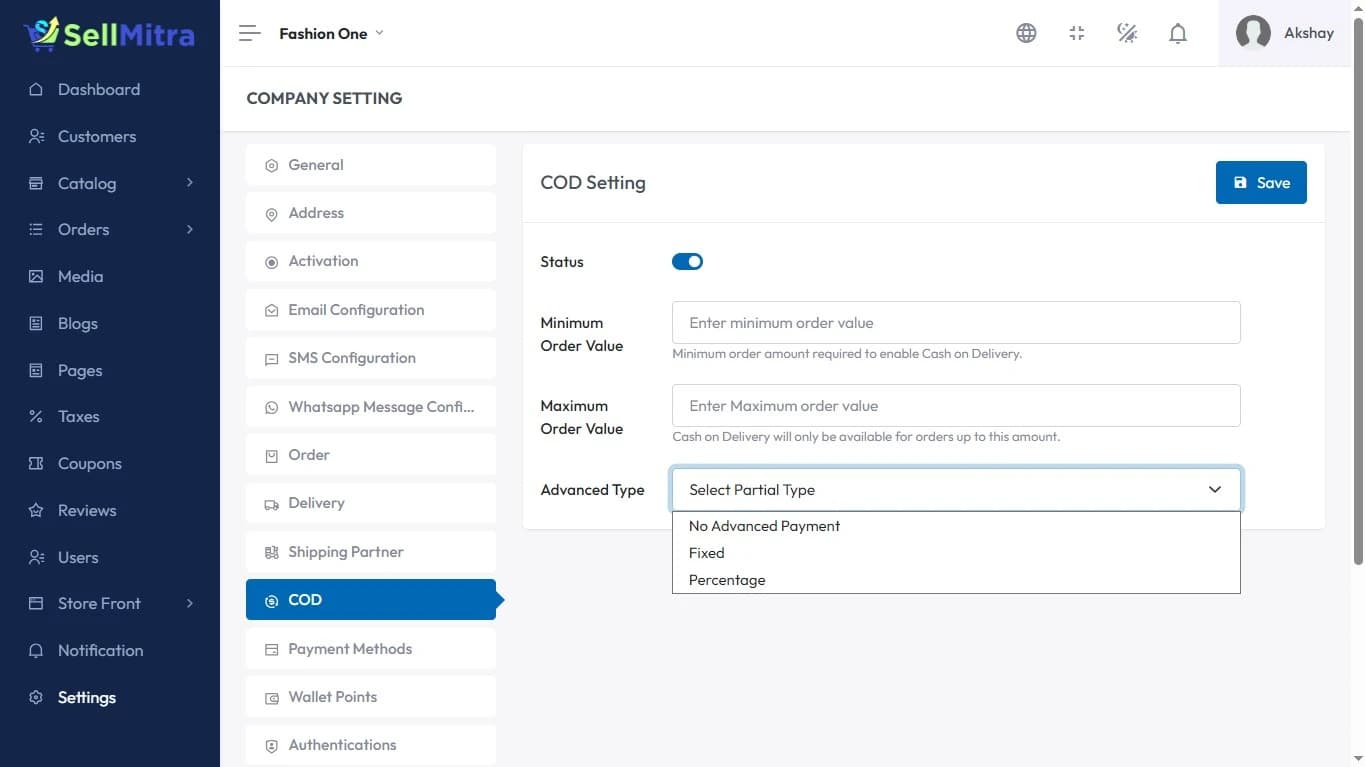
Key capabilities include:
Collect a predefined booking amount such as:
regardless of the order value.
Automatically calculate the advance based on the order total.
Examples:
Traditional COD gives customers complete flexibility but places most of the financial risk on the seller.
Full prepaid does the opposite.
It protects the seller but asks customers to trust the business completely before receiving the product.
Partial Advance Payment strikes a practical balance.
Customers pay only a small amount while placing the order and retain the convenience of paying the majority upon delivery.
Businesses receive greater confidence that the order is genuine and improve operational efficiency without removing COD entirely.
For many ecommerce brands, it isn't about replacing Cash on Delivery.
It's about making it more sustainable.
Cash on Delivery will continue to play an important role in Indian ecommerce because it builds confidence among shoppers and helps businesses attract new customers.
However, as businesses grow, they also need payment strategies that reduce unnecessary returns and improve profitability.
Partial Advance Payment offers a practical solution by combining the trust of COD with the commitment of an upfront payment.
Customers enjoy a flexible checkout experience, while businesses benefit from better order quality, healthier cash flow, improved inventory utilisation, and lower Return to Origin (RTO).
Rather than choosing between full prepaid and traditional COD, ecommerce businesses can adopt a smarter middle path that works for both customers and sellers.
With flexible configuration options such as fixed amounts, percentage-based advances, product-specific rules, and order value-based settings, Sellmitra makes it easy for merchants to implement Partial Advance Payment in a way that suits their business model.

Join our WhatsApp channel for quick tips, product updates, and ideas to help you grow your online store efficiently.
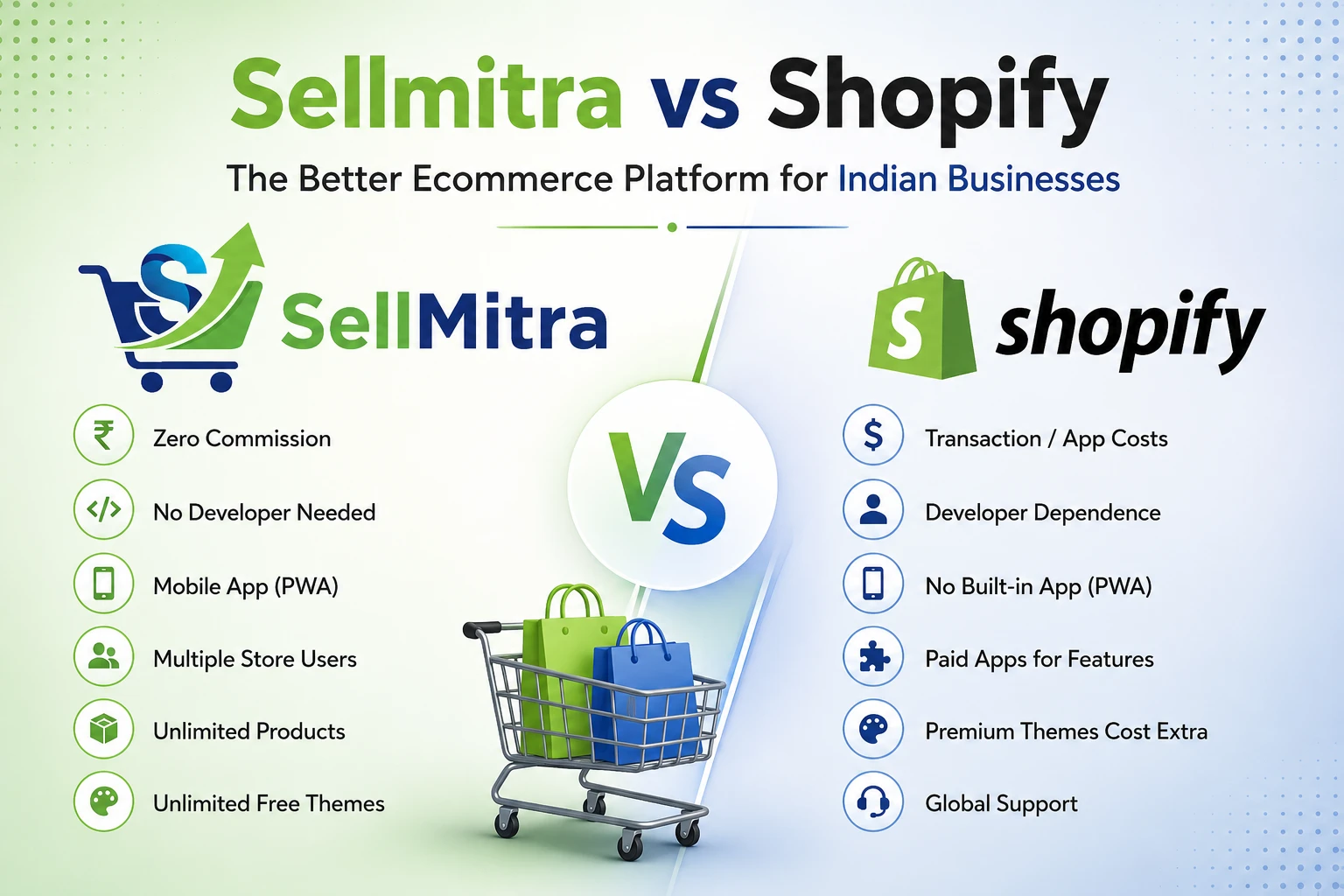
Compare Sellmitra and Shopify to find the right ecommerce platform for your business. Learn about pricing, mobile-first features, zero commission, and Indian-focused tools.

Discover why mobile apps are transforming ecommerce in India. Learn the benefits of PWAs, mobile commerce trends, and how they help grow sales.

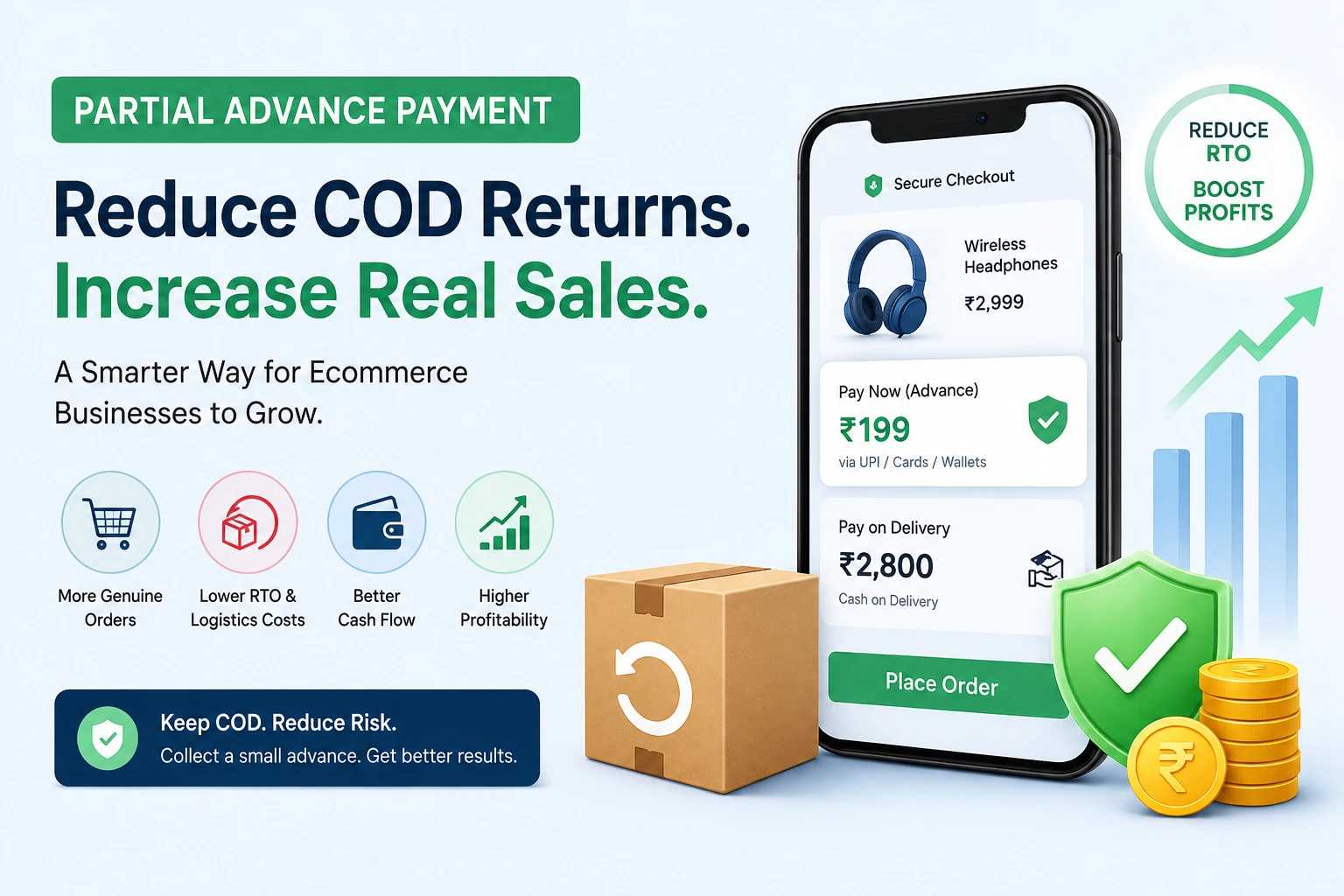
Learn how Partial Advance Payment helps ecommerce businesses reduce RTO, improve cash flow, increase genuine orders, and build customer trust without removing Cash on Delivery.
We can help you to create your dream website for better business revenue.